
5 Reasons Epoxy Flooring Is Ideal for Industrial Environments
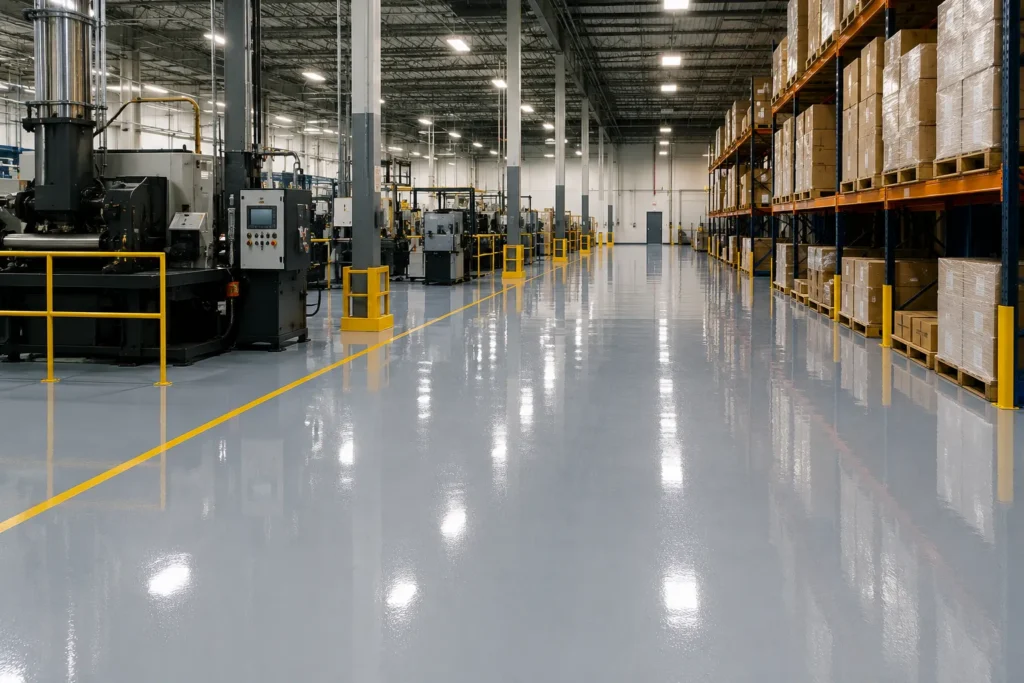
Epoxy Flooring has become one of the most trusted flooring solutions for industrial environments across the United States. Warehouses, manufacturing plants, logistics centers, food processing facilities, and automotive workshops increasingly rely on epoxy-coated surfaces to improve durability and workplace safety. According to the U.S. Bureau of Labor Statistics, slips, trips, and falls accounted for over 450,000 workplace injuries in 2024, making flooring performance a critical operational concern.
Industrial facilities face constant pressure from heavy machinery, forklift traffic, chemical exposure, and high foot traffic. Traditional concrete floors often develop cracks, dust accumulation, and surface deterioration over time. Epoxy Flooring addresses these challenges by creating a seamless, high-strength protective layer that extends floor lifespan and reduces maintenance costs.
Industry experts report that properly installed epoxy systems can last between 10 and 20 years in demanding environments. Installation costs typically range from $4 to $12 per square foot depending on thickness, surface preparation, and performance requirements. The combination of durability, safety, and cost efficiency explains why many facility managers choose epoxy over alternative flooring systems.
In this article, we explore five key reasons why Epoxy Flooring remains the preferred choice for modern industrial facilities.
Exceptional Durability Under Heavy Loads
Built to Handle Industrial Traffic
Industrial operations place significant stress on flooring systems every day. Forklifts, pallet jacks, storage racks, and production equipment create constant pressure that can quickly damage untreated concrete surfaces.
Epoxy Flooring forms a hardened protective layer capable of supporting thousands of pounds of continuous load. High-performance epoxy coatings often achieve compressive strengths exceeding 10,000 PSI. Standard concrete typically ranges between 3,000 and 5,000 PSI.
Our experience working with industrial flooring projects shows that facilities with epoxy-coated floors experience fewer surface repairs and less operational disruption. This durability helps businesses reduce long-term maintenance expenses while maintaining a professional appearance throughout the facility.
Key durability benefits include:
Resistance to heavy equipment traffic.
Reduced surface cracking.
Improved impact resistance.
Extended floor lifespan.
Lower maintenance costs.
Superior Chemical and Spill Resistance
Protection Against Harsh Industrial Substances
Industrial environments frequently handle chemicals, oils, solvents, and cleaning agents. These substances can penetrate concrete surfaces and cause long-term structural damage.
Epoxy Flooring creates a non-porous barrier that prevents liquid absorption. This protective layer helps facilities comply with workplace safety standards while reducing contamination risks. Manufacturing plants, automotive facilities, and chemical processing centers particularly benefit from this feature.
Industry testing demonstrates that quality epoxy coatings resist exposure to motor oils, hydraulic fluids, gasoline, acids, and alkalis. Maintenance teams can quickly clean spills before they affect production operations.
Floor protection also contributes to lower repair costs. Replacing damaged concrete sections can cost between $8 and $20 per square foot. Preventive protection through epoxy installation often proves significantly more economical over the facility’s lifecycle.
Enhanced Workplace Safety
Reducing Accidents and Improving Visibility
Safety remains a top priority for industrial facility managers. Workplace accidents result in lost productivity, higher insurance costs, and operational disruptions.
Epoxy Flooring supports safer working environments through customizable slip-resistant finishes. Specialized aggregates can be added during installation to increase traction in wet or high-risk areas. This feature is particularly valuable in warehouses, food production plants, and distribution centers.
Bright, reflective epoxy surfaces also improve lighting efficiency. Studies show that high-gloss epoxy coatings can increase light reflectivity by up to 300% compared to unfinished concrete. Better visibility helps employees identify hazards more quickly and operate equipment safely.
Safety improvements often include:
Increased slip resistance.
Better floor visibility.
Clearly marked walkways.
Enhanced emergency route identification.
Reduced dust generation.
Low Maintenance and Easy Cleaning
Saving Time and Operational Costs
Maintenance costs directly affect facility profitability. Traditional concrete floors produce dust and require frequent cleaning to maintain acceptable conditions.
Epoxy Flooring eliminates many common maintenance challenges by creating a smooth, seamless surface. Dirt, debris, and liquids remain on the surface rather than penetrating into the floor structure. Cleaning crews can remove contaminants using standard sweeping equipment and automatic scrubbers.
According to facility management surveys conducted in 2025, businesses with epoxy-coated floors reported maintenance cost reductions ranging from 20% to 35% compared to untreated concrete surfaces.
Our flooring specialists consistently observe faster cleaning cycles after epoxy installation. Reduced maintenance requirements allow staff to focus on core operational tasks while maintaining compliance with cleanliness standards.
Long-Term Cost Effectiveness
Maximizing Return on Facility Investments
Many decision-makers initially focus on installation expenses. However, evaluating flooring solutions based solely on upfront costs often leads to higher long-term expenditures. Explore our solutions for Epoxy Flooring.
Epoxy Flooring delivers substantial value through durability, reduced repairs, lower maintenance expenses, and extended service life. Facilities typically spend between $4,000 and $12,000 to install epoxy in a 1,000-square-foot industrial space. However, the reduced need for repairs and replacements often offsets the investment within several years.
The table below compares key industrial flooring characteristics.
| Feature | Epoxy Flooring | Untreated Concrete |
|---|---|---|
| Lifespan | 10–20 Years | 3–7 Years |
| Chemical Resistance | Excellent | Poor |
| Maintenance Needs | Low | High |
| Dust Generation | Minimal | Significant |
| Slip Resistance Options | Available | Limited |
| Installation Cost | $4–$12/Sq Ft | $2–$6/Sq Ft |
| Repair Frequency | Low | Moderate to High |
Businesses seeking predictable operating costs often view epoxy systems as a strategic facility improvement rather than a simple flooring upgrade.
Conclusion
Epoxy Flooring continues to be one of the most effective flooring solutions for industrial environments because it combines durability, chemical resistance, workplace safety, easy maintenance, and long-term value. Industrial facilities face demanding conditions that quickly wear down traditional concrete surfaces. Epoxy systems provide a protective barrier that withstands heavy traffic, resists spills, improves visibility, and simplifies cleaning operations. With service lives reaching 20 years and maintenance savings of up to 35%, epoxy remains a practical investment for warehouses, manufacturing plants, and distribution centers. For businesses seeking performance, reliability, and cost control, Epoxy Flooring offers a proven solution that supports both operational efficiency and workplace safety.